
RevPAR, ADR and Occupancy: How to Calculate the Hotel Revenue Management KPIs That Matter
Most hotel owners we speak to know their occupancy for last weekend. Far fewer can tell us their RevPAR, or whether it beat the hotel down the road. That gap matters, because occupancy on its own can hide a bad pricing decision. A 90% full hotel can be earning less than a 70% full one next door.
This guide explains the hotel revenue management KPIs our team checks every day, shows you how to calculate RevPAR, ADR and occupancy with simple rupee examples, and tells you which numbers to act on. If you would rather have experts track these for you, see our hotel revenue management services.
Quick answer
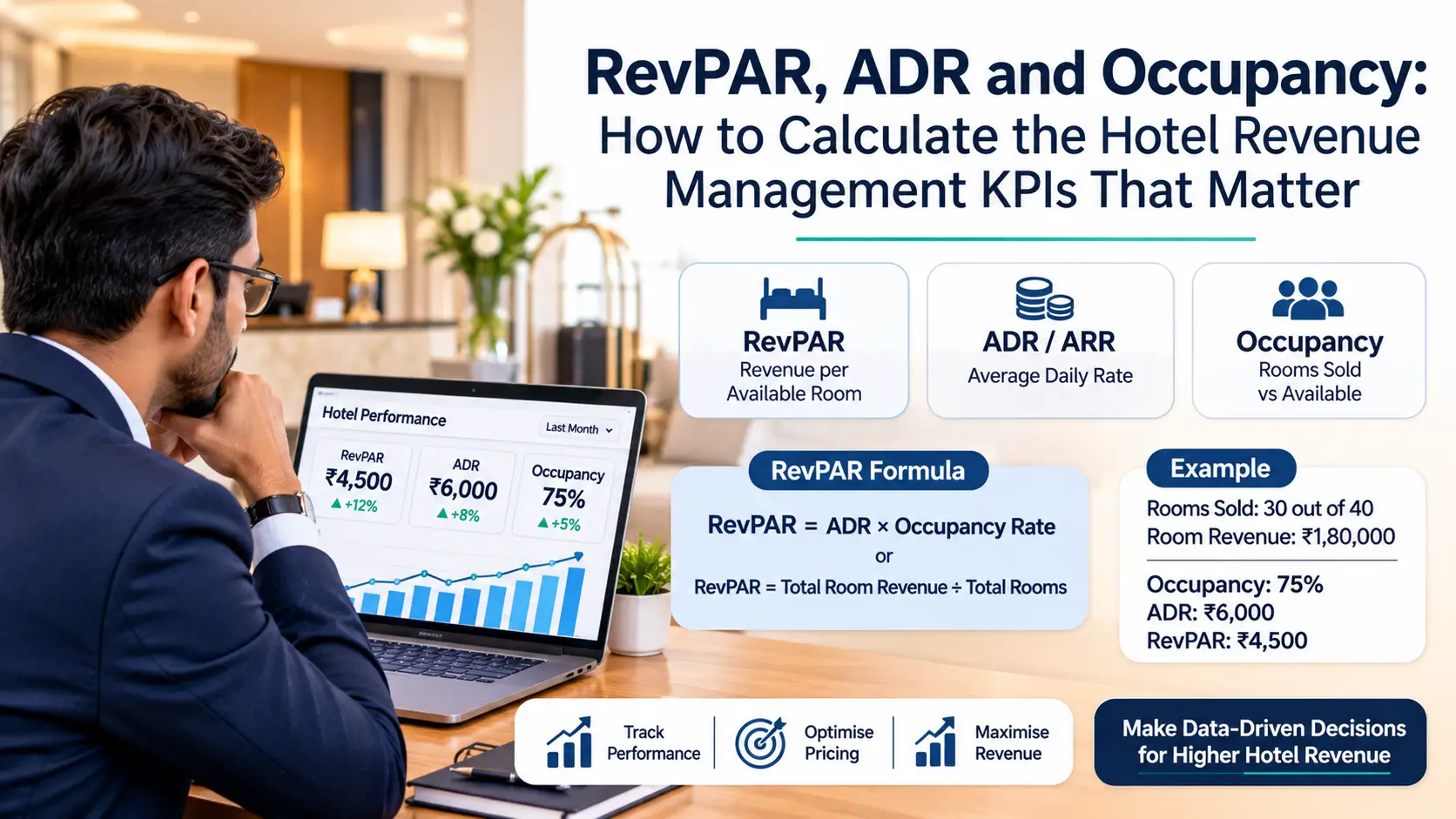
RevPAR formula: RevPAR = total room revenue ÷ total rooms available. You can also calculate it as ADR × occupancy rate.
ADR (average daily rate) = room revenue ÷ rooms sold. In India this is often called ARR (average room rate).
Occupancy rate formula: rooms sold ÷ rooms available × 100.
RevPAR is the most useful single number because it only rises when you balance price and occupancy well.
What is RevPAR in a hotel?
RevPAR stands for revenue per available room. It tells you how much room revenue each room in your hotel earned, whether or not that room was sold. Because empty rooms are counted too, RevPAR rewards hotels that fill rooms and hold rate, which is the whole point of hotel revenue management.
RevPAR formula with an example
There are two ways to use the RevPAR formula, and both give the same answer:
Method 1: RevPAR = total room revenue ÷ total rooms available. Use this when you have revenue totals from your PMS.
Method 2: RevPAR = ADR × occupancy rate. Use this when you are testing "what if" pricing ideas.
Example: a 40-room resort in Goa. On a Saturday in November, the resort sells 30 of its 40 rooms and earns ₹1,80,000 in room revenue (excluding GST).
Occupancy: 30 ÷ 40 × 100 = 75%
ADR / ARR: ₹1,80,000 ÷ 30 = ₹6,000
RevPAR: ₹1,80,000 ÷ 40 = ₹4,500 (or ₹6,000 × 0.75)
Tip: always calculate on room revenue net of GST and without food, spa or other income. Mixing these in makes your numbers impossible to compare with the market.
What is ADR (or ARR) in a hotel?
ADR in hotel terms is the average price paid for each room sold. Indian hoteliers and OTAs often call the same number ARR in hotel reports. The formula is room revenue ÷ rooms sold.
ADR tells you about price, not demand. A rising ADR with falling occupancy can mean you are pricing yourself out of your market. A falling ADR with flat occupancy usually means your discounts are not bringing in extra guests, they are just giving money away.
How do you calculate hotel occupancy rate?
The occupancy rate formula is rooms sold ÷ rooms available × 100. Count only rooms you could actually sell. Remove rooms that are out of order for renovation, but do not remove rooms blocked for staff or friends, because those are a revenue decision.
Why RevPAR beats occupancy: a real pricing choice
Here is a decision our team sees every week. The same Goa resort can either hold its rate or discount for next Saturday:
Plan A, hold rate: 30 rooms at ₹6,000 = ₹1,80,000. Occupancy 75%, RevPAR ₹4,500.
Plan B, discount: 38 rooms at ₹5,000 = ₹1,90,000. Occupancy 95%, RevPAR ₹4,750.
Plan B looks ₹250 better per room. But if 70% of bookings come through OTAs at 18% commission, NetRevPAR is ₹3,933 for Plan A and ₹4,152 for Plan B. Then take out about ₹700 to clean and service each occupied room, and the real gain shrinks to under ₹80 per room. Plan B also teaches repeat guests that your Saturday rate is ₹5,000.
The lesson is not "never discount". It is that the right KPI changes the answer. That is why good dynamic pricing strategies look at net revenue, not just how full the hotel is.
6 more hotel revenue management KPIs to track
NetRevPAR: (room revenue − commissions and distribution costs) ÷ rooms available. Shows what you actually keep, which matters most if OTAs bring most of your bookings.
TRevPAR: total revenue (rooms + F&B + other) ÷ rooms available. Useful for resorts and banquet-heavy hotels.
GOPPAR: gross operating profit ÷ rooms available. The closest KPI to owner profit. Track it monthly.
Channel mix: room nights by channel ÷ total room nights. Shows how dependent you are on OTAs.
Booking window: average days between booking and arrival. Tells you when to raise or lower rates.
Cancellation rate: cancelled bookings ÷ total bookings × 100. High rates on one OTA point to a policy problem, not a demand problem.
How do you know if your RevPAR is good?
A RevPAR of ₹4,500 means nothing on its own. It is strong in a quiet month in Lonavala and weak on New Year's Eve in Goa. To judge it, compare yourself with a competitive set (comp set) of 4 to 6 hotels your guests also consider, using three indexes:
MPI (occupancy index) = your occupancy ÷ comp set occupancy × 100. Example: 75% ÷ 80% = 93.8, so you are filling fewer rooms than the market.
ARI (rate index) = your ADR ÷ comp set ADR × 100. Example: ₹6,000 ÷ ₹5,500 = 109.1, so you are charging more than the market.
RGI hotel index (RevPAR index) = your RevPAR ÷ comp set RevPAR × 100. Example: ₹4,500 ÷ ₹4,400 = 102.3, so you are winning slightly more than your fair share.
A score above 100 means you are taking more than your fair share. In this example the resort wins on rate but loses on occupancy, so the next step is to test a small rate change on low-demand days.
Which KPIs to check daily, weekly and monthly
Daily: pickup for the next 30 days, occupancy on the books, competitor rates and your OTA ranking.
Weekly: ADR and RevPAR against the same week last year, channel mix, cancellations and no-shows.
Monthly: RGI, MPI and ARI, NetRevPAR, GOPPAR, and your seasonal revenue management plan for the next quarter.
5 common mistakes when tracking hotel KPIs
Including GST or F&B in room revenue. RevPAR looks higher than it is and stops being comparable.
Chasing occupancy. A full hotel at the wrong rate is the most common revenue leak we find in audits.
Picking the wrong comp set. Compare with hotels your guests actually see next to you on OTAs, not the most famous hotel in the city.
Ignoring OTA costs. Without NetRevPAR, a busy channel can be your least profitable one. Our guide to OTA revenue management explains how to fix this.
Only looking backward. Last month's RevPAR is a report card. Forward pickup is what lets you change the result.
How Hospitality Minds uses these KPIs
Our revenue managers work from these numbers every day for hotels, resorts and service apartments, from Goa and Kerala to Rajasthan and Himachal Pradesh.
For example, White Pearl, Colaba, a 28-room hotel in South Mumbai, moved its ARR from about ₹2,500 to ₹5,500 in eight months while growing online bookings from zero to 60% of its business. That came from pricing against demand and the comp set, not from cutting rates.
Want to know how your RevPAR and RGI compare with your market? Talk to our hotel revenue management company, see typical hotel revenue management cost in India, or book a free revenue audit.
Frequently Asked Questions
What is the formula for RevPAR?
The RevPAR formula is total room revenue ÷ total rooms available. You can also calculate it as ADR × occupancy rate. Both give the same answer.
What is the difference between ADR and RevPAR?
ADR is the average rate for rooms you sold. RevPAR spreads room revenue across every available room, sold or unsold, so it reflects both price and occupancy.
Is ARR the same as ADR?
Yes. In India, ARR (average room rate) is commonly used for the same figure: room revenue divided by rooms sold.
What is a good RevPAR for a hotel in India?
There is no single number. It depends on city, season and hotel type. Judge it with RGI: a score above 100 means you are earning more than your fair share against your competitors.
Should RevPAR include GST?
No. Calculate RevPAR on room revenue excluding GST and excluding F&B or other income, so you can compare it fairly over time.
How often should a hotel track RevPAR?
Check it weekly against last year, look at forward occupancy and pickup daily, and review RGI monthly.