Businesses in ChatGPT: What OpenAI’s New Business Hub Means for Hotels in 2026
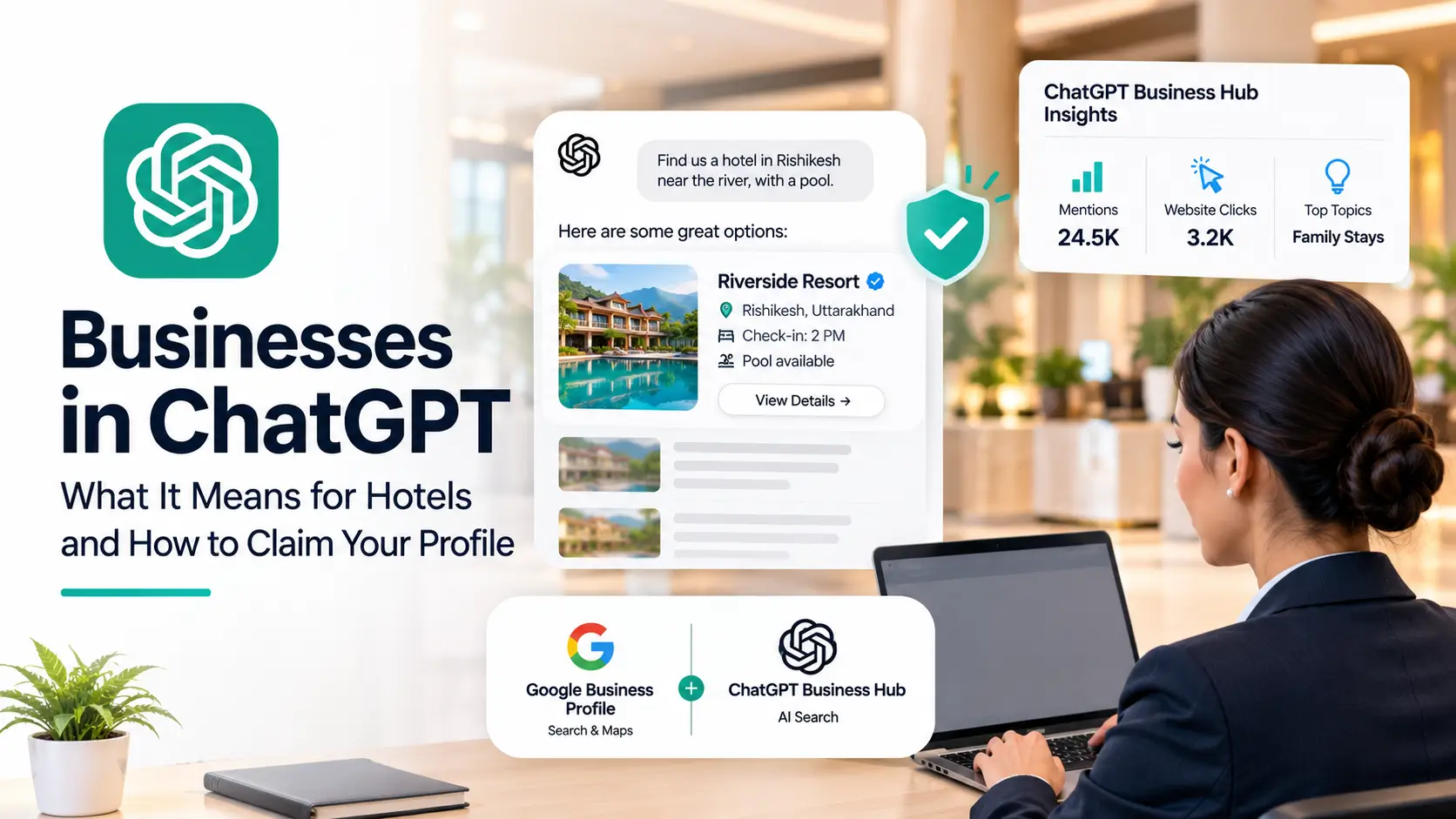
A family in Delhi asks ChatGPT: "Find us a hotel in Rishikesh near the river, with a pool and space for two kids, for the Christmas week." ChatGPT answers with three properties. One of them shows its correct address, its real check-in time, its current room types and a blue check next to its name. The other two show whatever ChatGPT could piece together from old reviews and OTA listings.
Which hotel would you rather be? On 10 November 2026, OpenAI launched Businesses in ChatGPT, a beta that lets businesses claim their profile inside ChatGPT, keep their details accurate and see how often ChatGPT mentions them. For hotels, it is the closest thing yet to a Google Business Profile for AI search.
This guide explains what was launched, what it means for hotels and resorts, how to claim your ChatGPT business profile, and what to do now so ChatGPT describes your property correctly.
Quick answer
OpenAI launched Businesses in ChatGPT in beta on 10 November 2026. It has three parts: Business Hub, Insights and Business Agents.
Business Hub lets a verified business claim its profile and update key details. A claimed profile shows a blue check.
Insights show aggregated mentions, website clicks and "discovery topics": the common themes in chats where your website is cited.
Business Agents let guests chat with an AI agent for your business inside ChatGPT. At launch, agents are only for eligible ecommerce and online service businesses in the United States.
Claiming is open to eligible businesses with a website in markets where ChatGPT is available. Eligibility depends on industry, location and verification, so hotels in India should try to claim and confirm.
Business Hub and agents are reported to be free during the beta.
Claiming does not buy you a higher position. ChatGPT still makes its own recommendations. Accurate data simply makes it easier for ChatGPT to match your hotel to the right conversations.
What is Businesses in ChatGPT?
Businesses in ChatGPT is OpenAI’s new way for companies to manage how they appear inside ChatGPT. OpenAI says ChatGPT now reaches about 1.2 billion people every week, and a growing share of them ask it where to eat, stay and shop. Until now, a business had no direct way to correct what ChatGPT said about it. This beta changes that.
Here are the three parts:
1. Business Hub
Business Hub (chatgpt.com/business-hub) is where you claim your business. After OpenAI verifies that you own or represent it, you can update details such as your name, category, address or service area, hours, contact details and products or services. Retailers can also add product feeds with prices and availability. Shopify merchants can connect their store directly, and existing OpenAI Enterprise customers and advertisers can claim through their OpenAI representative.
2. Insights
Once you have claimed your profile, Business Hub shows you aggregated numbers:
Mentions. How often ChatGPT surfaces your business. For a local business such as a hotel, OpenAI told Digiday a mention counts when ChatGPT shows a result for your location. Your brand name simply appearing in text does not count.
Website clicks. How many times users clicked a link to your website. These are link clicks, not confirmed visits or bookings.
Discovery topics. The common themes in conversations where your website is cited, for example "honeymoon stays", "family resort with pool" or "pet-friendly hotel".
OpenAI does not share individual conversations, and numbers only appear once activity passes a privacy threshold. Smaller properties may see little data at first.
3. Business Agents
After claiming, eligible businesses can build, test and launch an AI agent that answers questions about their offerings. When ChatGPT mentions a participating business, a user can open its profile and start a separate, clearly labelled chat with that business’s agent. The agent only uses the instructions and information the business provides. When the user is ready to buy, it sends them to the business’s own website.
At launch, Business Agents are limited to eligible ecommerce and online service businesses in the United States. OpenAI says it plans to add more markets and business categories. Hotels in India cannot launch an agent today, but should prepare for when they can.
Why this matters for hotels and resorts
Travel is one of the most natural things people use ChatGPT for. Guests ask it to compare destinations, shortlist resorts, check what is near a property and plan whole trips. If ChatGPT gets your details wrong, you lose the guest before they ever reach your website or an OTA.
Businesses in ChatGPT gives hotels four things they did not have before:
Control over your facts. Wrong check-in times, an old phone number, a closed restaurant or a missing pool can all be corrected at the source.
Trust at the moment of choice. A blue check tells the guest the profile is managed by the hotel itself, not pieced together from third-party sites.
Your first AI search data. Mentions, clicks and discovery topics show how ChatGPT sees your property and which guest needs it matches you to. Until now, hotels had almost no visibility into this.
A direct-booking path. Website clicks from ChatGPT go to your own site, not an OTA. Every booking that lands on your own booking engine instead of an OTA saves you 15 to 25 percent in commission.
It also fits with what OpenAI has already built for advertisers. Businesses can sponsor their Business Agent and use it as the destination for ChatGPT Ads, which went live in India in August 2026. In other words, the organic profile and the paid ad now point to the same place.
Google Business Profile vs ChatGPT Business Hub for hotels
Most hotels already manage a Google Business Profile. ChatGPT Business Hub does a similar job for AI search, but it is newer and works differently:
Google Business Profile | ChatGPT Business Hub | |
Where the guest is | Google Search and Google Maps | A ChatGPT conversation |
What you control | Name, address, hours, photos, posts, attributes | Name, category, address, hours, contact details, products or services |
Data you get | Views, searches, calls, direction requests, website clicks | Mentions, website clicks, discovery topics |
Reviews | Guests leave reviews on the profile | No reviews on the profile. ChatGPT draws on reviews from across the web |
Chat with the business | Business messaging has been discontinued | Business Agents (US ecommerce and online services only at launch) |
Maturity | Mature, proven for hotels | New beta, eligibility still rolling out |
You need both. Google is still where ready-to-book guests search. ChatGPT is increasingly where guests plan, compare and shortlist before they search.
How to claim your hotel on ChatGPT: step by step
OpenAI has not published a hotel-specific process, so follow the general steps below and check the live Business Hub before you start:
Collect your official details first. Use exactly the same hotel name, address and phone number as your website and Google Business Profile. Consistency helps ChatGPT match your profile to everything else it knows about you.
Go to chatgpt.com/business-hub and start a claim for your property, logged in with an account your hotel controls (not a staff member’s personal login).
Verify ownership. Reports say verification is done by a text or call to your main business number, or by adding a DNS record to your website domain. Make sure the number listed on your website reaches someone who can respond, and keep your web team ready for DNS.
Complete every field. Category, address, hours, reception and reservation contacts, and a clear list of what you offer: room types, restaurant, spa, pool, banquet and meeting space, airport transfers and packages.
Link to your direct booking page. Your website is the destination for clicks, so make sure it opens fast on mobile and shows live rates.
Check your Insights after a few weeks. Note your mentions, clicks and discovery topics, and compare them month to month.
If you run a chain or group, claim each property separately and keep one owner account so nothing is lost when staff change. If your hotel already advertises on ChatGPT, ask your OpenAI representative whether you can claim through them.
What to do after you claim: make ChatGPT describe your hotel correctly
A claimed profile is a starting point. ChatGPT still builds its answers from everything it can find about your hotel, so the rest of your online presence matters just as much.
Keep your facts consistent everywhere
Your name, address, phone number, check-in and check-out times, amenities and policies should match across your website, Google Business Profile, OTAs, TripAdvisor and social profiles. Conflicting information makes AI tools less confident about recommending you.
Write for the conversations guests actually have
Discovery topics show you the themes ChatGPT links to your website. Build pages around them. If guests ask about "family resort near Jim Corbett with kids’ activities", you need a page that answers that question clearly, with facts, distances and prices.
Create dedicated pages for each guest segment: couples, families, corporate offsites, weddings, workations and long stays.
Add clear FAQ sections on room, policy and location pages.
Use hotel schema markup so AI crawlers can read your property details, room types and FAQs.
Allow OpenAI’s crawlers (OAI-SearchBot) in your robots.txt so ChatGPT can cite your website.
Manage reviews actively
ChatGPT reads reviews from across the web. A steady flow of recent, detailed reviews, and polite replies to negative ones, gives it better material to describe your property.
Keep rates in parity
A ChatGPT click is wasted if your website rate is higher than the OTA rate. Good revenue management and rate parity control turn AI visibility into direct bookings.
Limits and open questions hotels should know
Eligibility is not guaranteed. OpenAI says not every business can claim a profile, and eligibility depends on industry, location and verification. It has not published a list of eligible countries or categories.
No Business Agents for hotels yet. Agents are US-only for ecommerce and online services at launch. Even when they come, OpenAI’s policy says agents cannot complete bookings without explicit user authorisation through an approved feature.
No ranking boost. OpenAI says claiming should not change how often you appear. It helps ChatGPT surface you in more relevant conversations, but it does not buy placement.
Limited data for small hotels. Insights only appear above privacy thresholds, and clicks are not bookings. Use your own analytics and booking engine data to measure revenue.
Profiles can include other sources. OpenAI does not verify every detail and may show information from elsewhere. The blue check means the profile is claimed, not that every fact is validated.
It is a beta. Features, eligibility and pricing may change. Free today does not guarantee free later.
A 30-day action plan for your hotel
Week 1: Audit what ChatGPT currently says about your hotel. Ask it 10 to 15 questions a guest might ask and note every wrong or missing fact.
Week 2: Fix your facts on your website, Google Business Profile and OTAs. Then claim your profile in Business Hub and complete every field.
Week 3: Add or improve FAQ content, schema markup and segment landing pages. Check your robots.txt allows OAI-SearchBot.
Week 4: Review your first Insights, if available. Ask ChatGPT the same questions again and compare the answers. Plan content around your discovery topics.
How Hospitality Minds can help
Hospitality Minds is a hotel marketing and revenue management company working with hotels and resorts in India and abroad. We help properties get found and booked across Google, OTAs and now AI assistants such as ChatGPT.
Our team can audit how ChatGPT and other AI tools describe your hotel, claim and set up your ChatGPT business profile, fix inconsistent data across channels, build the content and schema that AI search relies on, and connect it all to a fast direct-booking website and smart pricing.
Want to know what ChatGPT is telling guests about your hotel today? Talk to our team for a free AI visibility check.
Frequently Asked Questions
What is ChatGPT Business Hub?
Business Hub is the part of OpenAI’s Businesses in ChatGPT beta where a business claims and verifies its profile, updates its details and sees aggregated insights such as mentions, website clicks and discovery topics.
When did OpenAI launch Businesses in ChatGPT?
OpenAI launched Businesses in ChatGPT in beta on 10 November 2026.
Can hotels in India claim their business on ChatGPT?
Claiming is open to eligible businesses with a website in markets where ChatGPT is available, and ChatGPT is available in India. OpenAI has not published a list of eligible categories, so the best way to confirm is to start a claim at chatgpt.com/business-hub.
Is ChatGPT Business Hub free?
Business Hub and Business Agents are reported to be free during the beta. OpenAI has not ruled out paid features later.
Will claiming my profile make ChatGPT recommend my hotel more?
Not directly. OpenAI says claiming does not guarantee higher placement, and ChatGPT still makes its own recommendations. Accurate, complete information helps ChatGPT match your hotel to more relevant conversations.
Can my hotel create a ChatGPT Business Agent?
Not yet. At launch, Business Agents are only for eligible ecommerce and online service businesses in the United States. OpenAI plans to expand to more markets and categories.
Can I see what guests ask ChatGPT about my hotel?
No. OpenAI does not share individual conversations. You see aggregated mentions, website clicks and discovery topics once activity passes privacy thresholds.
How is this different from ChatGPT ads?
Business Hub is your organic profile. ChatGPT ads are paid, labelled "Sponsored" placements below an answer. Businesses can sponsor their Business Agent and use it as an ad destination, so the two now work together.