Hotel SEO Agency vs In-House SEO: What Actually Moves Bookings in 2026
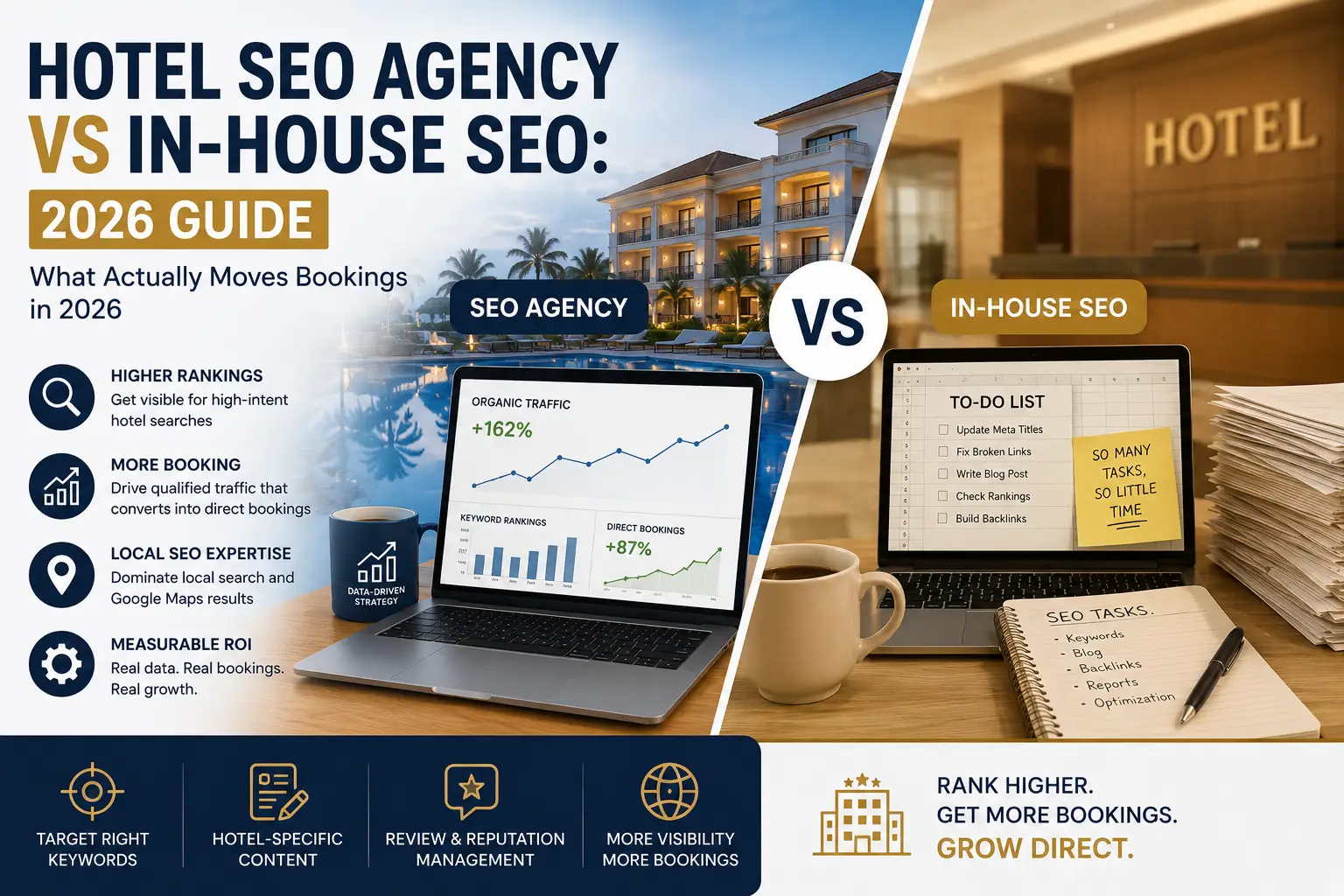
If your hotel's website isn't showing up when guests search "hotels near me" or "best resort in [your city]," you're losing direct bookings to every competitor who ranks above you — regardless of how good your property actually is. This is where the decision between hiring a specialised SEO agency for hotels and trying to manage rankings in-house becomes critical. Hotel SEO is a different discipline from generic SEO — it involves local search, OTA competition, seasonal demand spikes, and guest intent that behaves nothing like e-commerce or B2B search behaviour. In 2026, with AI-driven search results and increasingly crowded SERPs, generic or half-managed SEO simply isn't enough to move the needle. This article breaks down what a dedicated hotel SEO company actually does differently, and why that difference shows up directly in your booking numbers, not just your rankings report.
Why Generic SEO Doesn't Work for Hotels
Most in-house teams or generalist agencies apply the same SEO playbook to a hotel website that they'd use for any other business — target a few keywords, publish some blogs, build a few backlinks, and wait. The problem is that hotel search behaviour is fundamentally different. Guests search with location-specific intent ("boutique hotel in Goa," "resort near Mumbai airport"), compare rates across OTAs before even reaching your website, and often search via voice or map-based queries rather than typed keywords. A true SEO services for hotels provider understands that ranking well means optimising for local pack results, Google Business Profile visibility, and OTA-adjacent search terms simultaneously — not just chasing generic keywords. Seasonal demand also plays a huge role: search volume and intent for "hill station resort" spikes months before summer, and a hotel-focused SEO strategy plans content and technical work around that calendar. Without this specialised understanding, in-house efforts often optimise for the wrong keywords entirely — ones with low intent or high competition from OTAs that a single hotel property can rarely outrank without a dedicated strategy.
What a Specialised Hotel SEO Company Actually Does Differently
A genuine Hotel seo company builds its strategy around three pillars: technical SEO, local search optimisation, and content built specifically for guest research behaviour. Technical work includes site speed, mobile usability, and structured data that helps Google understand your room types, pricing, and amenities directly in search results. Local optimisation goes far beyond a basic Google Business Profile listing — it includes citation building, review management, and location-specific landing pages for hotels with multiple properties or nearby attractions. On the content side, a specialised partner writes around real guest questions — "things to do near [property]," "best time to visit [destination]" — that capture guests earlier in their planning journey, well before they're comparing rates on OTAs. This is paired with hotel content marketing that keeps your blog active and relevant rather than stagnant, which search engines increasingly reward. The combined effect is a website that ranks for the searches that actually convert into bookings, not just traffic that never translates into revenue.
In-House SEO: Where It Falls Short
Managing SEO in-house isn't impossible, but it usually fails for the same handful of reasons. First, hotel staff — front office managers, marketing executives, or general managers — are rarely dedicated full-time to SEO, so technical issues like broken links, slow page speed, or missing schema markup go unnoticed for months. Second, in-house teams often lack access to the tools needed for proper keyword research, competitor tracking, and backlink audits, so strategy becomes guesswork rather than data-driven. Third, content consistency suffers — blogs get published sporadically instead of on a strategic publishing calendar, which search engines interpret as low site authority. Fourth, and most critically, in-house teams rarely have visibility into what's happening on the digital marketing side, so SEO efforts and paid campaigns end up disconnected rather than reinforcing each other. None of this means in-house SEO can't work for very large hotel groups with dedicated marketing departments — but for independent hotels and boutique resorts, the resource gap almost always shows up in stagnant or declining rankings over time.
Measuring SEO ROI: What Hotels Should Actually Track
Rankings alone don't pay the bills — bookings do. A results-focused SEO agency for hotels should report on metrics that connect directly to revenue: organic traffic growth, keyword ranking movement for high-intent terms, direct booking conversions from organic search, and reduction in OTA-dependency over time. Bounce rate and average engagement time also matter — if guests are landing on your site and leaving within seconds, your rankings might improve while your bookings don't, which signals a content or user-experience mismatch rather than an SEO win. It's worth running a periodic hotel performance audit to check whether SEO gains are actually translating into revenue, or just vanity metrics on a dashboard. You can see how this played out for a real property in our SEO case study, where a focused SEO strategy delivered measurable improvements in both rankings and direct booking volume within months, not years.
Choosing the Right SEO Partner for Your Hotel
When evaluating a hotel-focused SEO agency, ask for case studies from properties similar in size and category to yours, and request a transparent breakdown of what "SEO work" actually includes each month — technical fixes, content publishing, backlink building, and local optimisation should all be itemised, not bundled vaguely into a retainer. A strong partner will also tie SEO strategy to your broader digital marketing and online reputation management efforts, since reviews and reputation directly influence local search rankings. Hospitality Minds works exclusively with hotels and resorts, combining technical SEO, hotel-specific content strategy, and performance marketing so that every ranking gain is built to convert into actual bookings. You can explore results across different property types on our case studies page, or review our full services.
Conclusion
The choice between an in-house team and a dedicated hotel SEO agency ultimately comes down to specialisation and bandwidth. Generic SEO tactics rarely hold up against the seasonal, local, and OTA-driven complexity of hotel search behaviour, and stretched-thin in-house teams often can't keep pace with the technical and content demands modern search requires. A specialised partner brings the tools, hotel-specific strategy, and consistent execution needed to turn rankings into real, trackable bookings rather than just traffic numbers.
Want to know where your hotel's SEO currently stands?
Talk to Hospitality Minds for a free SEO and website performance review tailored to your property.